
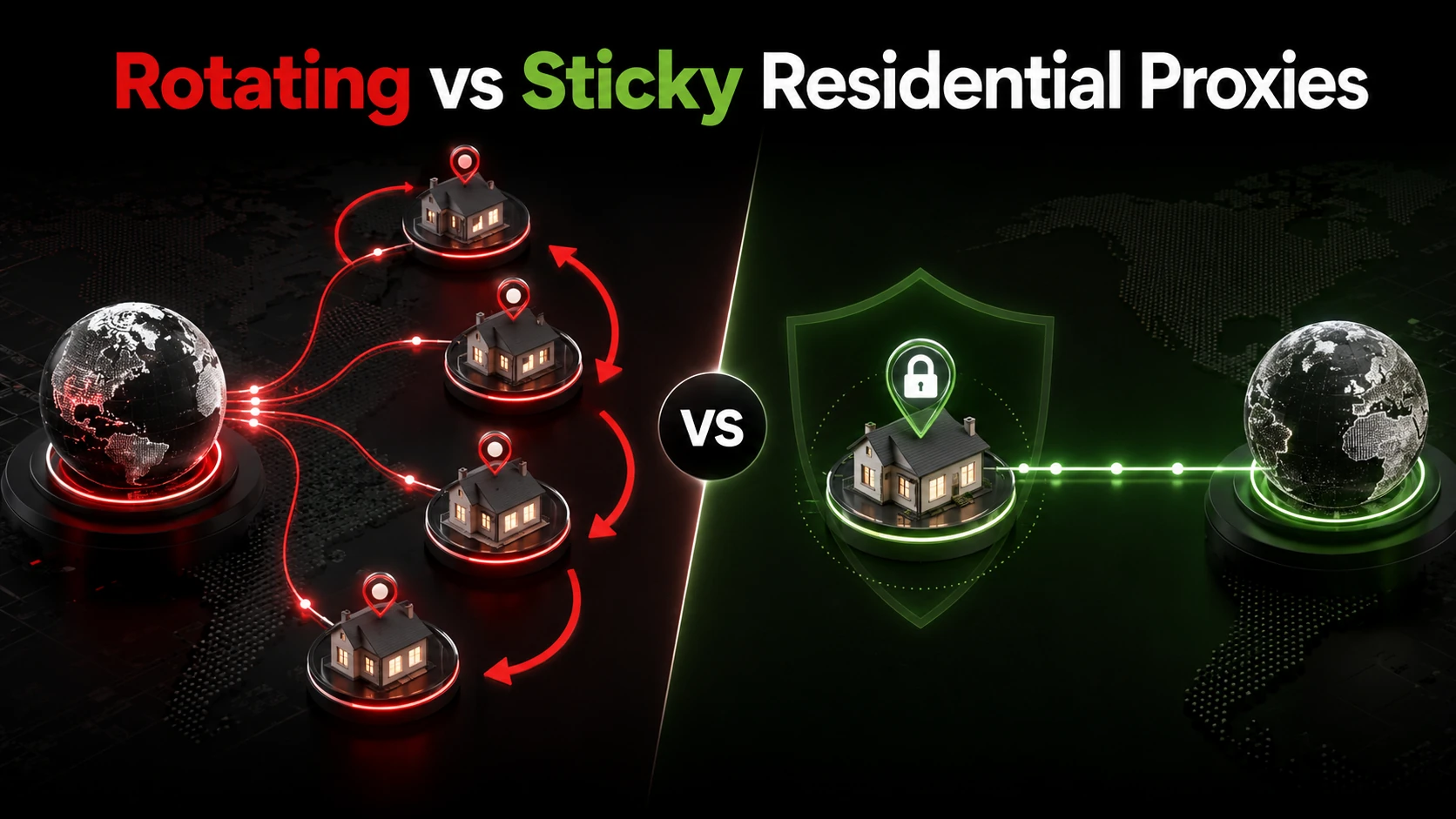
Rotation and stickiness are not rival features competing for the same slot. They are two answers to a single question: how long should the destination keep recognising you? Answer it wrongly and the symptom is rarely slowness. It is a workflow that completes four steps out of five and then quietly starts again.
This article sets out how residential session control actually behaves, which workloads belong on per-request rotation, which need a held exit address, and how to configure the boundary so a change of policy never requires a change of code.
What rotation really controls
A rotating residential gateway assigns a fresh exit address on a schedule you choose: on every request, after a fixed interval, or when a session identifier changes. The pool behind the gateway is shared, so the address you receive is drawn from whatever is currently online in the requested region. That is the source of both the strength and the limitation. Spread across many households, request volume looks ordinary; concentrated in one, it does not.
Sticky sessions invert the arrangement. The gateway reserves an exit for a defined window, typically anywhere from one minute to twenty-four hours depending on the provider, and routes every request carrying the same session token through it. Cookies, cart state and signed-in views survive, because from the far side of the connection nothing changed.

Match the setting to the shape of the flow
The useful test is not the size of the job but its dependency structure. Sketch the request sequence. The moment one step needs something the previous step produced, rotation stops being free and starts costing you completed work.
- Independent requests — catalogue sweeps, availability polls and ad placement checks carry no state and benefit from spreading across the widest pool available.
- Short chains — search, then open a result, then read a detail page usually needs continuity for a minute or two, not for an hour.
- Long journeys — anything involving a basket, a signed-in dashboard, or a paginated result set with a server-side cursor needs one address for the whole run.
- Recurring identity — workflows a destination is entitled to recognise across days belong on static residential addresses rather than on either gateway mode.
Session length has a cost on both sides
Holding an address is not free, and neither is releasing it too eagerly. A long sticky window ties up an exit that the provider cannot lend to anyone else, which is why some plans meter sticky duration more tightly than raw traffic. A very short window forces repeated handshakes, and each new connection carries its own protocol overhead that lands on the same gigabyte counter as your useful payload.
| Setting | Typical window | Suits | Watch for |
|---|---|---|---|
| Per-request rotation | New exit every call | High-volume independent reads | Broken multi-step flows |
| Short sticky | 1 to 10 minutes | Search-then-open chains | Expiry mid-journey |
| Long sticky | 30 minutes to 24 hours | Carts, dashboards, cursors | Address reuse limits |
| Static residential | Weeks or months | Approved recurring identity | Per-address pricing |
Configure the boundary, not the behaviour
The single most useful engineering decision here is to keep session policy out of application code. Rotation interval, sticky duration and the session identifier format all belong in configuration, so the policy can be tuned against a live destination without a deployment. Teams that hard-code a fifteen-minute window spend the next quarter negotiating with their own release process.
Log the address against the session
Record which exit served which session identifier, and for how long. When a journey fails at step four, that log answers in seconds whether the session expired, whether the destination refused the address, or whether the application simply lost its own cookie.
Alert on expiry, not only on failure
A session that ends mid-flow usually produces a redirect to a login page rather than an error code, so success-rate monitoring stays green while the work quietly stops being useful. Watch for the redirect pattern directly and treat it as an expiry signal.
Revisit the setting when the destination changes
Continuity requirements move whenever a site reworks its sign-in, checkout, or pagination. A flow that ran happily on ten-minute stickiness for a year can start failing the week a destination introduces a server-side cursor. Re-reading the flow after any visible redesign is cheaper than debugging the pipeline that used to work.
The same applies in reverse. Sites that simplify their journeys sometimes free a workload from stickiness altogether, and moving it back to rotation reclaims reserved capacity you are still paying for.
How pool depth changes the rotation calculation
Rotation only spreads load if there is somewhere to spread it. A gateway advertising a very large global pool can still be shallow in a single metropolitan area, and per-request rotation inside a shallow segment recycles the same handful of exits rather than distributing across many. The result looks like aggressive rotation in your configuration and like repeat traffic from a small set of households at the destination.
The practical check is simple: run a modest sample against your narrowest target region, record the distinct exit addresses observed, and compare that count with the volume you intend to run. Where the distinct count is low, widen the region, lower the concurrency, or accept a slower schedule. Increasing rotation frequency is the one adjustment that will not help.
Concurrency interacts with the same limit. Twenty parallel workers inside a thin segment compete for the same exits, and providers that cap simultaneous sessions per address will start refusing connections long before the traffic allowance runs out.
Continuity behaves differently per protocol and client
Session control is negotiated at the gateway, but it is experienced through whatever client library sits in front of it, and the two do not always agree. Connection pooling in an HTTP client can keep a socket alive past the point the gateway considers the session finished, producing a request that appears to succeed while arriving from a different exit than the previous one. Disabling keep-alive for the duration of a sticky journey is a blunt fix that removes an entire class of confusing failures.
SOCKS5 and HTTP endpoints can also expose different session semantics on the same account, with one honouring a token in the credential string and the other expecting a distinct port per session. Headless browsers add a third layer, because each browser context maintains its own cookie jar and may open parallel connections that the gateway counts as separate sessions. Confirm the behaviour once per client stack and record it, rather than assuming the documented gateway behaviour reaches your code unchanged.
Settings that are routinely confused
Rotation interval is not session lifetime
An interval governs how often the gateway is willing to hand you a new exit. A session lifetime governs how long a specific exit stays reserved for a given token. A plan can advertise both, and the shorter of the two is what your workflow experiences.
Sticky is not static
A sticky session holds a shared address temporarily and returns it to the pool afterwards. A static residential address is assigned to your account and remains yours across days or weeks. They solve different problems and are usually priced on different units.
Session identifier format matters
Most gateways read the session token from the username field, and a token that changes when it should not, because it embeds a timestamp or a random component regenerated per request, silently converts stickiness back into rotation. Print the assembled credential once during integration and read it.
Session control, condensed
- Map every multi-step flow end to end
- Decide the shortest session that still completes
- Log the address used per session identifier
- Alert when a session expires mid-flow
- Keep the rotation policy in configuration