

The advertised rate per gigabyte tells you remarkably little about what a month will cost. What decides the invoice is how much traffic crosses the wire before a usable result comes back, and that ratio is set by your own pipeline far more than by the vendor price list.
Bandwidth forecasting for residential proxies is therefore an exercise in measuring waste. This article covers the billing models in use, how to build an estimate that survives contact with production, where traffic actually disappears, and which controls keep a spike from becoming an unbudgeted invoice.
Two billing models, rarely comparable
Rotating residential networks overwhelmingly bill for data transferred, because the underlying capacity is distributed across consumer connections that the provider does not own outright. Static residential and ISP products more often attach a fee to each address held on reserve, and backconnect veterans sometimes sell rotating ports with no traffic meter at all.
Those units do not convert cleanly. A port-based plan looks expensive next to a per-gigabyte rate until a heavy month arrives, at which point the fixed cost becomes the cheaper of the two. Establish which model a quote uses before comparing any numbers, and convert both to the same denominator: cost per successful record.
Build the estimate from a measured response
Guessing from page weight in a browser is the most common estimating error, because a browser fetches assets your collector may not need and caches ones it does. Capture a genuine response from a real target through the proxy itself, note the transferred size, and work upward from there.
Then multiply by attempts rather than successes. A pipeline running at a ninety per cent success rate with two automatic retries transfers materially more than the record count suggests, and retry amplification is the single largest source of surprise in residential proxy budgets.
| Input | How to obtain it | Common mistake |
|---|---|---|
| Payload per request | Measure a live response through the proxy | Reading page weight in a browser |
| Attempts per record | Successes plus retries plus discards | Counting only stored records |
| Daily record target | Business requirement, not engine capacity | Sizing to maximum throughput |
| Regional multiplier | Sample the most expensive market | Averaging every market together |
| Buffer | A stated percentage, agreed in advance | An unstated “bit extra” |
Find the traffic that never becomes a record
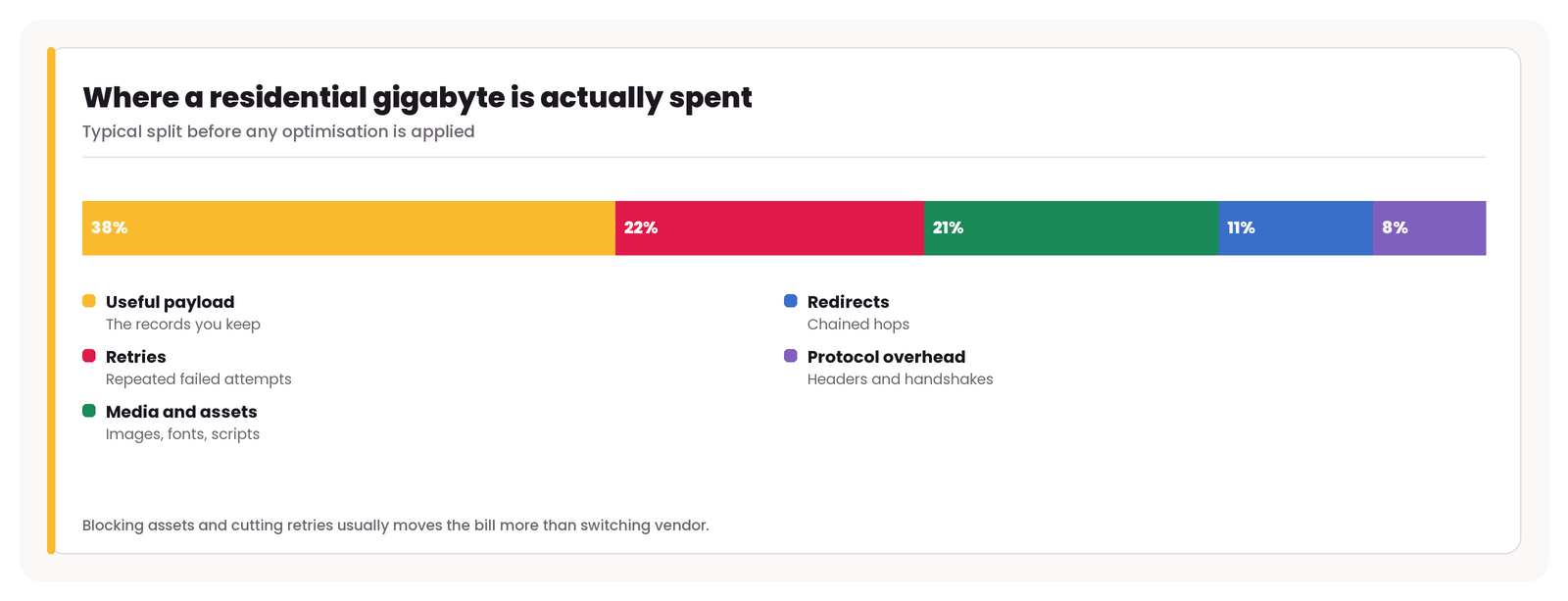
Before negotiating a lower unit rate, look at what the current rate is being spent on. In most unoptimised collectors the useful payload is a minority of the bill, and the remainder is recoverable without any vendor conversation at all.
- Images, web fonts and analytics scripts fetched by a headless browser that never reads them
- Retries against destinations that were never going to answer that request
- Redirect chains followed to completion when the first hop already carried the answer
- Oversized API responses requested without a field filter the endpoint supports
- Duplicate collection caused by two schedules overlapping on the same target set
Blocking non-essential asset types where the destination permits it, capping redirect depth, and de-duplicating the schedule frequently move the monthly figure further than a negotiated discount would.
Put a ceiling under the account before you scale
Cap first, alert below the cap
Set a hard spending limit, then place a notification threshold beneath it so somebody hears about the trend before the ceiling is reached. An alert on its own does not stop anything; a cap on its own tells you only after the pipeline has already halted.
Decide the automatic top-up question deliberately
Automatic replenishment is convenient and is also how a misconfigured loop becomes a four-figure surprise. If it stays enabled, bound it: a maximum number of top-ups per billing period, and a message to a channel a human actually reads.
Recalculate whenever the target changes
A destination redesign can double payload overnight without any change on your side, and a new market can carry a different regional multiplier entirely. Treat the bandwidth model as a living estimate reviewed on the same cadence as the collection schedule, and record the assumptions beside the number so the next person can see which one broke.
Where a plan carries an expiry rule on unused traffic, that review has a deadline attached. Balances that lapse quietly at the end of a period are the least visible line item in residential proxy spending and among the easiest to eliminate.
Static residential is priced on a different axis
Where rotating plans meter movement, static residential and ISP products meter possession. You reserve a set of addresses for a period, and the bill barely moves whether you send a hundred requests through them or a hundred thousand. That inverts the entire optimisation exercise: payload trimming stops mattering and utilisation starts mattering, because an address sitting idle costs exactly as much as one working continuously.
The comparison trap is to place a per-address monthly fee next to a per-gigabyte rate and conclude that one is dearer. Convert both to your own workload first. A modest job with strict identity requirements is often cheaper on a handful of reserved addresses; a broad sweep across many regions is almost always cheaper metered. Estates running both should review the split annually, because a workload that grew into a metered plan may have grown back out of it.
Negotiate from evidence rather than volume
Discount conversations go better when they are anchored to a measurement. A team that arrives with a documented monthly volume, a payload profile and a stated growth curve is asking a vendor to price a known quantity. A team that arrives asking for a better rate is asking to be moved one tier down a published table, which the table already anticipated.
The most valuable concessions are frequently not the unit price at all. A longer expiry window on unused traffic, a higher included concurrency, a documented escalation contact, or a mid-term plan change without penalty each change the effective cost of ownership more than a few percentage points on the headline rate. Ask for the terms that reduce your risk, and let the rate settle where the table puts it.
Where two vendors land close together, the tie-breaker worth using is billing transparency: the one whose dashboard shows consumption in near real time will save more engineering hours over a year than the one whose figures arrive with the invoice.
Three numbers worth reporting every month
Cost per successful record
Total spend divided by records the business actually kept. It is the only figure that survives a conversation outside the engineering team, and it moves whenever either side of the ratio changes, which makes it a useful early warning.
Wasted transfer share
The proportion of transferred bytes that produced nothing storable. Tracking it separately stops a rising bill being blamed on the vendor when the cause is a collector that started following an extra redirect chain.
Balance at period end
How much of the purchased allowance went unused, and whether it carried forward. Persistent leftover balance means the plan is oversized; a balance that repeatedly lapses means the commitment shape is wrong rather than the price.
Bandwidth planning, condensed
- Capture payload size on a real target
- Multiply by attempts, not by successes
- Block media downloads where permitted
- Set an alert beneath the hard cap
- Review cost per useful record monthly