
Proxy authentication decides who is allowed to spend your bandwidth. It is typically configured once, during an integration sprint nobody revisits, and then left alone for years. That combination is exactly why leaked proxy credentials stay useful to whoever finds them long after the team that created them has moved on.
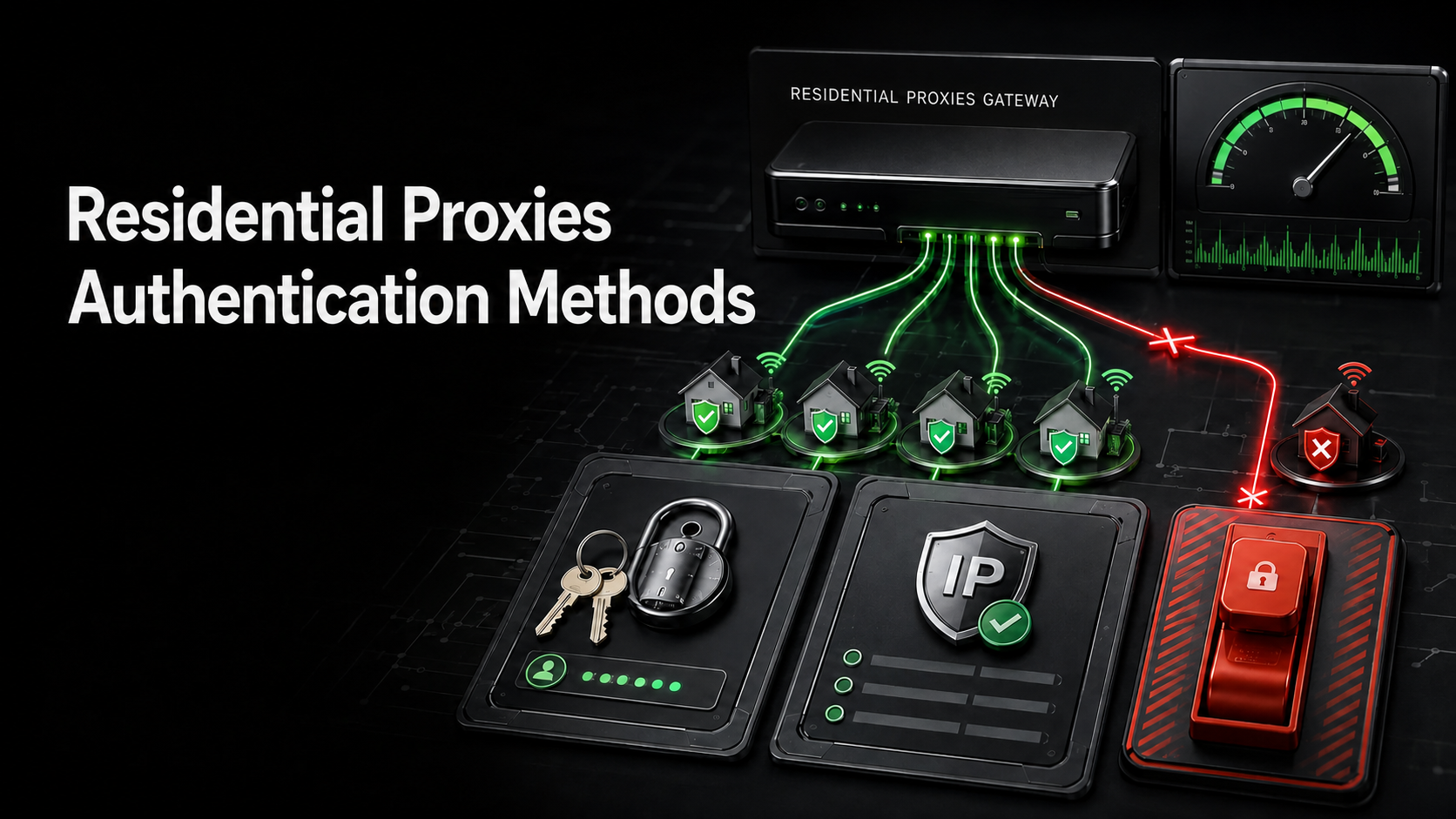
Two access models dominate residential networks: a username and password pair carried in the connection string, and an allowlist that binds access to the egress addresses you declare. They make opposite assumptions about your infrastructure, they fail in opposite ways, and most mature estates end up running both deliberately rather than choosing one by default.
What each model actually assumes
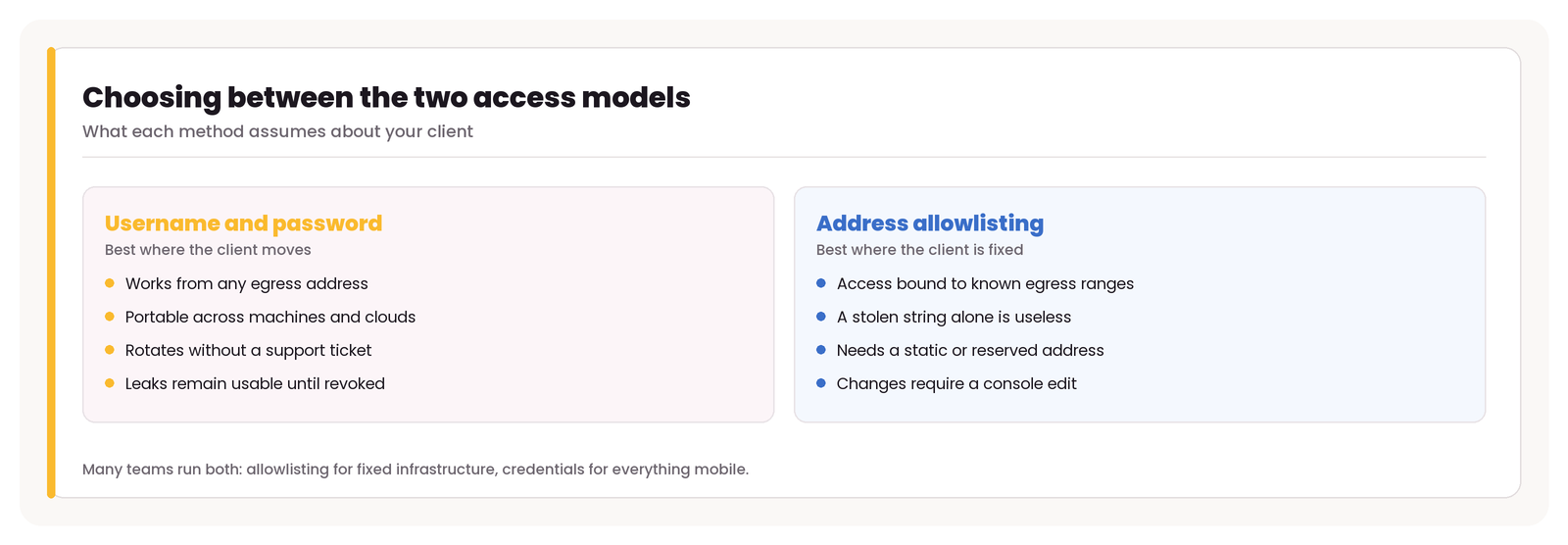
Credential authentication assumes the client can move. The pair travels with the request, so a job runs identically from a laptop, a scheduled container, or a function that receives a fresh egress address on every invocation. That portability is the feature, and it is also the exposure: anyone holding the string has the same access from anywhere, and the network cannot tell the difference.
Allowlisting assumes the client is fixed. Access is granted to declared source addresses, so a stolen credential string on its own is inert. The cost is operational rigidity: every new worker, every redeployment onto a fresh address range, and every migration between regions requires a console change before traffic will flow.
Choosing per workload rather than per account
The question is not which model is safer in the abstract but which one matches the shape of a given job. A nightly collection running from a fixed set of instances in one region is a natural allowlist candidate. A developer investigating a failing target from a laptop is not, and forcing it into an allowlist produces a shared credential smuggled around the policy instead.
- Fixed infrastructure with reserved egress addresses belongs on an allowlist
- Ephemeral compute with rotating egress belongs on scoped credential pairs
- Ad-hoc human investigation belongs on short-lived credentials issued per person
- Third-party or contractor access belongs on a sub-account that can be closed independently
- Anything running outside your own network perimeter belongs on the tightest option available
Where a provider supports both simultaneously, combining them is stronger than either alone: a credential pair that only works from declared ranges requires an attacker to hold the string and be inside the network.
Scope credentials to jobs, not to people or teams
The single change that most improves incident response is issuing one credential per workload. It costs nothing at creation time and changes everything at revocation time: killing a compromised string takes down one job rather than the entire estate, and the usage graph attached to that string tells you immediately which pipeline was affected.
Shared credentials fail the opposite way. When a single pair serves six pipelines, nobody can revoke it during business hours, so the response to a suspected leak becomes a scheduling negotiation. By the time a window is agreed, the exposure has been live for days.
| Practice | Effect during an incident | Cost to adopt |
|---|---|---|
| One credential per workload | Revoke without an outage | A few minutes at setup |
| Secrets in a manager | Rotate centrally, no code change | One integration |
| Allowlist on fixed egress | A stolen string is unusable | A console entry per range |
| Sub-accounts per team | Close access independently | Available on most plans |
| Usage caps per credential | Bounded loss before detection | Set once, review quarterly |
Where credentials actually leak
Proxy strings rarely escape through anything sophisticated. They escape through a committed configuration file, a container image layer that captured an environment variable, a screenshot pasted into a ticket, or a debug log that recorded the full connection URL including the password field. Every one of those is a habit rather than a vulnerability, which is why the fix is procedural.
Keep the pair in a secrets manager and inject it at runtime; scrub credentials from log output at the library level rather than by convention; and treat any string that has been in a chat message as already compromised. Rotation on a fixed schedule matters because exposure is usually discovered long after it happened, and a schedule bounds how long an unnoticed leak stays valid.
Operational details that decide the day-to-day
Test both methods against one endpoint
During integration, exercise the credential path and the allowlist path against the same destination. When something fails later, you will know whether the failure belongs to the authentication method or to the network, which removes the most common wasted hour in proxy debugging.
Watch for allowlist drift
Cloud egress ranges change, NAT gateways get replaced, and an allowlist entry that was correct at launch silently stops matching. Schedule a review alongside infrastructure changes rather than waiting for a pipeline to fail at three in the morning.
Keep a revocation runbook
Write down where each credential lives, which job uses it, and the exact steps to revoke and reissue. The value of that page is that somebody who did not build the system can execute it under pressure.
Rotate without stopping the pipeline
The reason scheduled rotation gets skipped is that it is assumed to require downtime, and for a badly structured integration it does. The fix is to make the change a data change rather than a deployment. If the collector reads its credential from a secrets manager at the start of each run, rotation is a console action followed by the next scheduled execution picking up the new value with nobody watching.
Where a provider allows two active credentials at once, overlap them. Issue the replacement, let both work for a scheduled cycle, confirm the new one is carrying traffic, and only then revoke the old. That pattern removes the last argument against rotating on a calendar, because the risky moment — the gap between old and new — no longer exists.
Sub-accounts are the cheapest blast-radius control
Most residential plans include sub-users at no extra cost, and most buyers never create one. A sub-account per team, per contractor and per external integration means access can be withdrawn without touching anything else, and consumption can be attributed without an investigation. It converts a single shared surface into several small ones that fail independently.
Review access on the same cadence as the plan
Authentication decays quietly. People leave, projects end, contractors finish, and the credentials issued for them keep working because nothing forced a review. Attaching an access review to the renewal date gives it a natural trigger: list every active credential, name the workload and owner for each, and revoke anything nobody claims.
The same review is the right moment to check whether the provider has added controls since you integrated. Per-credential usage caps, IP allowlists on sub-accounts and audit logs appear in these products regularly, and they are frequently switched off by default on accounts created before they existed.
Access control, condensed
- Issue one credential per workload
- Allowlist stable egress addresses
- Store secrets outside the repository
- Rotate on a fixed schedule
- Revoke immediately on any suspicion